Thursday, March 19, 2015

Finding Home: Other Voices

It's my pleasure to share the work of Seattle author, Kit Bakke. She offers much to ponder.


Dream Home 
 
Home, I think, is always in our past and never where we are. Being thus untethered in time and space, we are free to make it up. We shove the dark spots into the background, highlight the good parts, make home whatever we need it to be. We do this for our own reasons, but always to distinguish it from where we are right here and now.

In 1973 I was living in a cheap apartment off Alcatraz and Grove streets in Oakland CA. It was a warm summer. The Nixon Watergate hearings were on TV nonstop. It was a pleasure and a relief to see the man finally fall. My other preoccupation was that I was pregnant with my first child and was busy catching up on the women’s movement. I read a lot—Doris Lessing’s Martha Quest series, Anais Nin’s diaries, Virginia Woolf’s everything, Ms. Magazine.

In one of the Martha Quest books, Lessing describes the British settlers in Zimbabwe, or Rhodesia as it was in the days she lived there. She wrote that the colonial British housewives didn’t hang curtains in their kitchen windows, didn’t plant flowers by their front doors. They did nothing to indicate to themselves that this was their home. And yet they did stay, for years, for decades, for their whole lives—never admitting to themselves that this could be home, never investing in their community, learning about their African environment or allowing themselves to be comfortable there.

That image of refusing to make a home in the place where you are has not faded in the forty years since I read the book. To me, it points to a road not to take, a person not to be. It’s fine to put soft edges around a place and time in our pasts—we all need our memories to keep us warm from time to time—but isn’t it more interesting and entertaining to make your home wherever you are?  
 Kit Bakke’s most recent book is Dancing on the Edge. Although she lived a peripatetic life for many years, she’s pretty much returned to her Seattle birthplace.


Don't want to miss a single post? Get them delivered by entering your email in the box in the lower right column.

Tuesday, March 17, 2015

Finding Home: Walnut Avenue


My sister, two and a half years my senior and the youngest of the four Big Kids, insists I always hid my glasses in the sandbox and she had to search for them. I was born cross-eyed and have worn glasses since I was about three years old (except during my vain years, when I only wore them to read, fumbling along the rest of the time). The sandbox must have been at the Walnut Avenue house - nice yard, lots of space - but Dad could have built one at the Shorewood house as well.
My father built almost every house I lived in throughout the seventeen years I was with my first family and almost every house he and my mother shared during their fifty-year marriage. All but one. The Walnut Avenue house in the Admiral District of West Seattle was the only exception.

The house Dad didn't build stands regal on a curved, tree-lined residential street. The color seems familiar, as if still dressed in the original paint, though I know this is impossible. The backyard still abuts the deep, undeveloped Fairmount Ravine these sixty years later. In the mid-1950s when my folks owned this house, the street hosted perhaps half the number of houses now crowding the once spacious lots a half block from Hiawatha Park and Community Center, two blocks from Lafayette Elementary School, three from West Seattle High School.

My siblings and I did not attend my father's alma mater having moved to the Issaquah Valley before any of us reached our teens. Attendance at West Seattle High School skipped a generation. Only my daughter followed my father's footsteps.

When is memory real? When is it based on photos and family lore? I cannot claim a solid memory of digging holes in a sandbox to hide glasses I didn't want to wear, but my sister claims I did just that. And more than once. In a family of older kids keeping an eye on younger kids, she'd know. It was her job to keep those glasses on my stubby nose.

My four older siblings attended Lafayette Elementary School. They walked the two blocks together, and I was left behind. Too young for kindergarten, I stayed home with a mother who lost one child to miscarriage before my birth and another after. A mother whose husband left Seattle to work on a pipeline in Ketchikan, Alaska when I was two years old. I have no idea how long he was gone, just as I have no memory of my mother's grief. Still, as a woman and a mother myself, I am certain that despite her German stoicism, my mother suffered deeply. Alone, we must have shared long hours of pain after my older siblings skipped off to school. But the house, the beautiful graceful house, was not to blame.
Of all the places I have lived, the Walnut Avenue house is the one I'd like to re-enter. I can see myself on the front porch or climbing the wide curving staircase to the second floor, my hand sliding along the polished mahogany. One day I will garner the nerve to knock on the front door. "I once lived here," I will say. "Should you ever decide to sell, please let me know." I will offer a card with name and phone number, and I will cross my fingers that they invite me inside.

Thursday, March 12, 2015

Finding Home: Other Voices

I'm pleased to launch Finding Home: Other Voices, a platform for guest writers to ponder the question: What is home?

To kick off this Thursday series, I know you'll enjoy the work of poet, playwright and author Pamela Hobart Carter.


RAISED AND RAZED 

Only house our children knew, where they were raised,
(only children raised in our old house)—waits to be razed.
Mirror-mantel with mottled green tile will grace
another house. Men will salvage and scavenge
her wood, her radiators. Men will flatten
her asbestos siding, her lath, her plaster.
Men will dig where Edna has stood one hundred
and eleven years. I demark the raising
of my children, their chalk hopscotch on front walk,
their slides in shorts down her grass as if on sleds
in snow, with orange cones. Men cannot raze games:
their hide-and-seek, their chase, their splendid stair-ball
invented for her carpeted risers, nor
careenings on her bannister. They cannot
erase images, the house we added to—
dark built-ins for our books, pale green tiled shower,
closets where she had few, fresh elegant paint,
and a garden we raised in borroweds and blues.
Whetherbe built two yellow quartermasters,
one, at his fort, and ours, on the quiet street.
Ours shimmied from her central axis, windows
skipped a beat, yardstick slipped: aging dowager,
misapplied lipstick sitting crooked across
her smile, unphased. We sold her to be razed.

Seattle resident Pamela Hobart Carter grew up in Montreal, Quebec. A geologist by training, Carter has taught everything from preschool to science pedagogy. She practices timed writing with two Seattle groups. Recently Carter began to wield poetry for the purpose of eliminating hunger.
 
 
Don't want to miss a single post? Get them delivered by entering your email in the box in the lower right column.

Tuesday, March 10, 2015

Finding Home: The Shorewood Shack


The Shorewood shack was my parents' first home as newlyweds in 1947. It made my mother's parents cry in dismay. But Dad was undeterred. They had a roof over their heads and land to build on.

Dad poured a foundation, framed, wired, plumbed, and roofed the place. He worked full time and built in his "free time" after putting in his daily shifts as a union steamfitter. I don't know how long it took before the new house stood fresh and shiny on a tiny dead-end street called Marine View Drive, but I know it was sold about six years after Dad broke ground. I have no memory of the original shack, and no idea what became of it. Maybe it became a garden shed. Maybe a garden shop. Maybe they tore it down in celebration.

The Shorewood house was Dad's first construction project. I wonder what a nightmare it must have been for both my parents. Or maybe an adventure? They were young. World War II had ended. Life was full of hope and opportunity. In those first five years of marriage, they had four children and built their first house.

They went on to have nine kids and build seven more houses.

But were they ever homes? What makes a home? A putting down of roots? A sense of belonging to both place and community? I'm hesitant to use the word home. I'm unsure whether any of the houses Dad built were homes. For me, there is a difference. I don't know that such a difference existed for my parents. At times I think their houses were only investments.
Until recently, I’d believed I was carried home from Providence Hospital in my mother's arms to breathe the fresh autumn salt air of Puget Sound, the blue of sea and sky merging on the horizon. Simple mathematics tell me I was wrong.

My older siblings were school-age, when I joined the family as the fifth child, six years behind the first. My folks wanted them close to a quality elementary school. Through sweat equity they'd increased the value of the Shorewood property sufficiently to flip it (in today's parlance) and buy a house in a more desirable area of West Seattle. When my mother carried me home, it was to a craftsman home on Walnut Avenue, not to the newly completed Shorewood house, but more about that next week.
Yet, I have this photo of myself in front of the Shorewood house. I must have been about three. I'm not wearing my glasses, but I hid those whenever I could. My mother rarely dated photographs, and I was too little to remember much at all, but according to family lore the sale of the Shorewood house fell through. Keeping two houses was out of the question, an offer came on the Admiral house, and leaving in Seattle was already under consideration, so my parents packed up the five of us and returned to Shorewood. About a year later we moved into a tent, and another construction zone, in the Issaquah Valley.

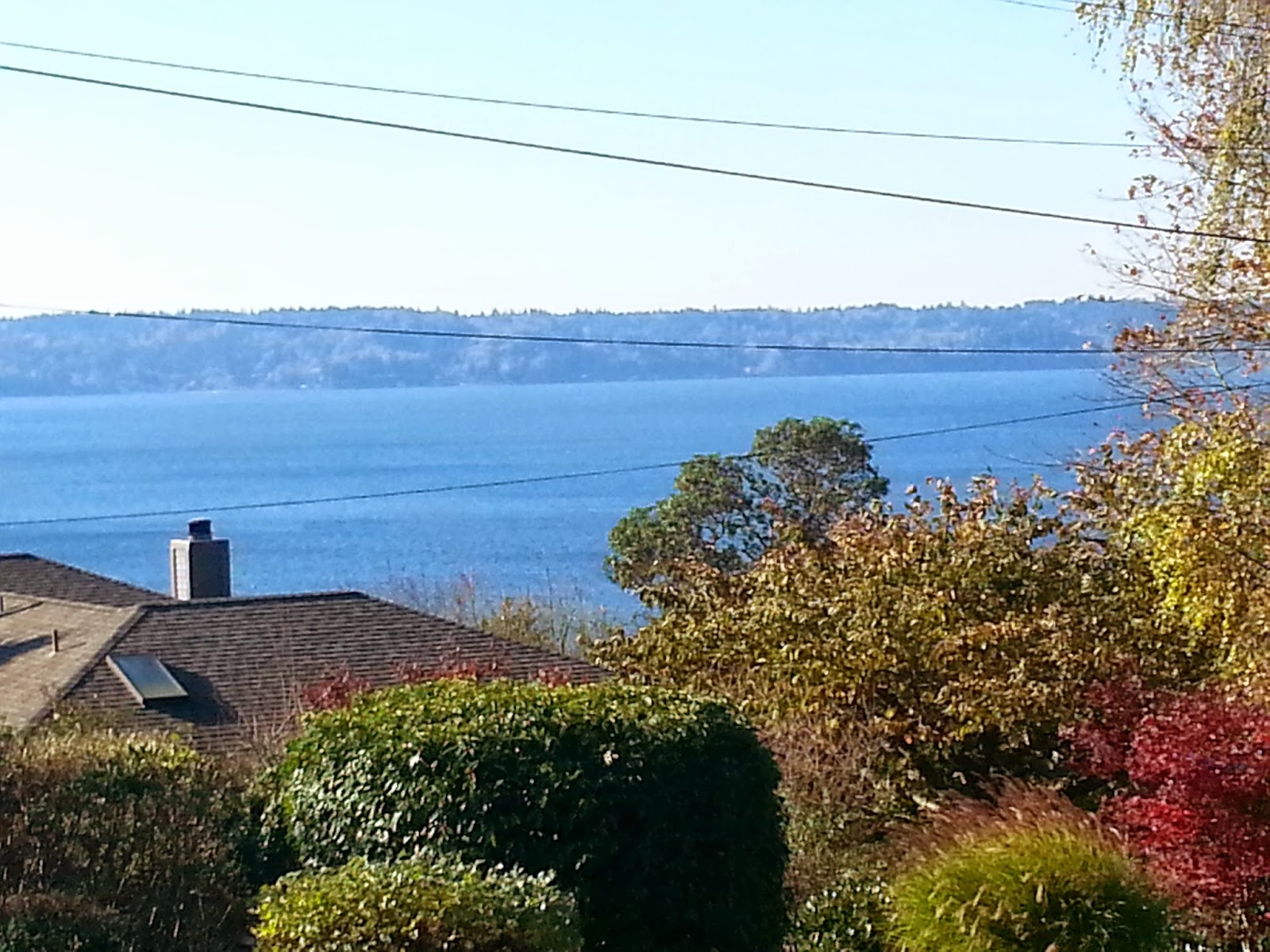
Sorting my parents’ belongings after Dad died and Mom was in a dementia care facility, I found the address of that first house. I punched it into the GPS and went exploring. The house is in the Shorewood neighborhood of Burien, not Seattle at all. Although the surrounding area is now completely developed, Dad's original construction still stands on a dead-end street. His house is freshly painted and well-loved, the large-paned windows facing west with a breath-taking view of Puget Sound.

Thursday, March 5, 2015

Finding Home: Prologue


My husband and I have a house that is a home. It is a small 1941 "war box" in a community we love in West Seattle. We have remodeled extensively—taking down walls, finishing the basement, and building on a sunroom to add space to an 800 square foot home.

We have lived in this house for twenty four years, raised our daughter here, and shared the joys and sorrows of families around the globe within its walls. I belong to this house and to this community just as they belong to me. I have found my home. But it took time, and it wasn't always easy.

In my sixty years, I've had fifteen or twenty homes, depending on how they're counted. Home is the wrong word. Abodes, shelters, places I slept? These residences include houses my father built; dorm rooms; apartments in Seattle, Santa Cruz, Caracas, Mexico City; even a high-rise restroom during a brief period of homelessness, a time of transition; and now a house that is a home. I have lived here longer than any other place, including my childhood home in the Issaquah Valley nestled at the foot of the Cascade Range where I lived from age four to seventeen.

Home is the place we belong, where our roots run deep. A place where walls, people, and community hold us. For some that sense of belonging, of finding home, is as natural as breathing. For others it can be a lifelong journey. Most of us struggle with belonging, whether as a student in the lunch room of a suburban middle school, as an immigrant in a new land, or as an elder moving into assisted living.
When birth family does not exist, or is insufficient to fill their needs, my Alki Trilogy characters find home by building a family of friends. The third novel of the trilogy, Walking Home, is a story about searching for a place to nourish the soul and provide sanctuary from violence. In celebration of its upcoming publication, I'll be sharing a series of posts exploring my own search for home—the memories and emotions around each of the places I've lived. I hope you'll join me on this journey.

For regular post updates, please follow this site by entering your email in the box in the lower right column.